Call Center Traffic Calculator Software
A custom traffic calculator for call centers that need to model staffing, call load, ASA targets, queue behavior, TSF, and hourly what-if scenarios. Built from real-world telecom software experience — not spreadsheet guesswork.
What this calculator helps solve
This calculator is designed for call center teams that need quick planning answers. You can estimate how many agents are needed for a target hour, or solve the other way around and estimate how many calls a given staffing level can support.
Enter queue averages
Input your expected hourly call volume, ACD handling time, wrap-up time, answer-speed target, and abandon behavior.
Choose what to solve for
Calculate either required agents per hour or supported calls per hour based on the traffic assumptions.
Select the right formula
Use Erlang C, Erlang B, or Poisson depending on queue behavior, blockage assumptions, and retry patterns.
Traffic inputs
The values below represent the types of operational inputs this calculator uses.
- Calls Per Hour — the number of incoming calls expected during the hour being evaluated.
- Agents Per Hour — the number of staffed agents available to handle queue traffic.
- D.C. Processing — average direct call processing time, also known as talk time.
- P.C. Processing — average post-call work or wrap-up time after each handled call.
- Goal ASA — target average speed of answer, in seconds.
- Non-ACD Calls — average non-queue calls per agent during the hour.
- Non-ACD Call Time — average duration of those non-ACD calls.
- Avg Wait Before Abandon — average time callers wait before giving up.
Example screen
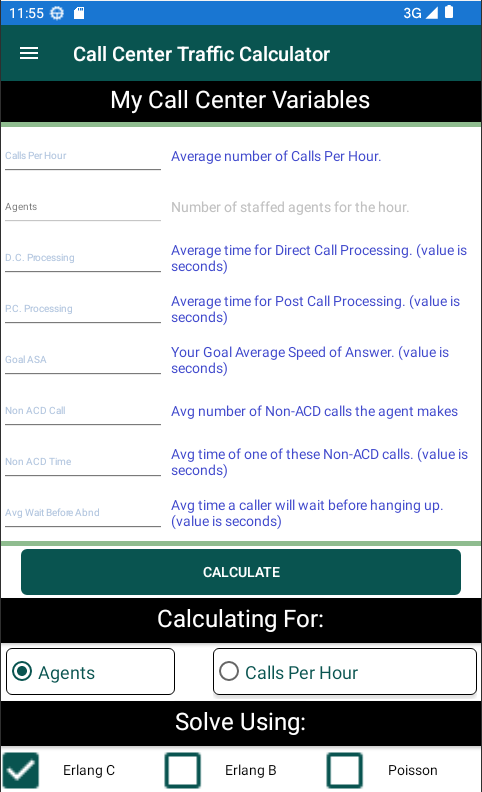
This image uses your existing calculator screenshot asset. It drops cleanly into the newer site style without the old header and navbar baggage.
Formula options
Different call center environments need different assumptions. This calculator can be positioned around the three classic traffic models below.
Erlang C
Best for queue-based environments where callers wait for an available agent. Useful for estimating delay, staffing needs, and service-level performance. In practice, this is often the most useful model for a typical inbound queue.
Erlang B
Better suited to scenarios where blocked calls are treated as lost rather than queued. It is often used for trunking and first-attempt call situations with low blockage.
Poisson
A retry-oriented assumption set commonly used in trunk studies. It can overestimate requirements when callers do not keep retrying indefinitely.
Mobile app screenshots
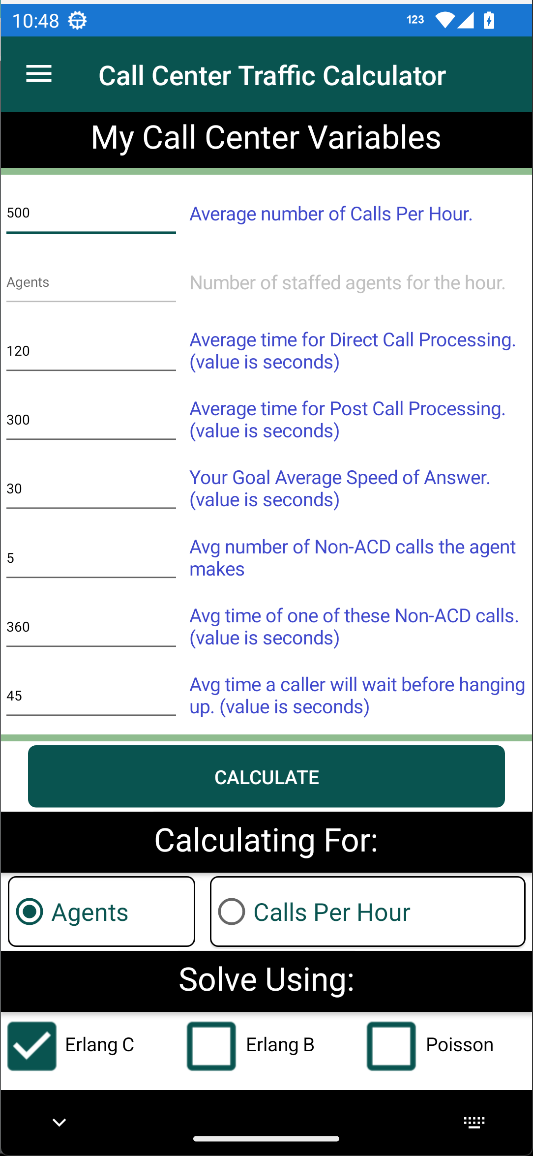
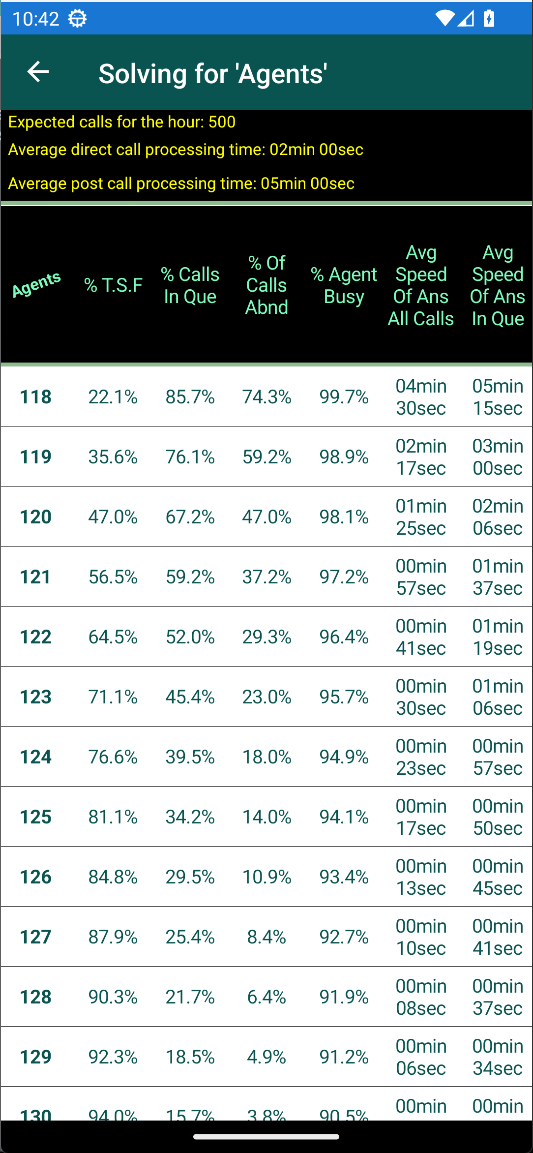
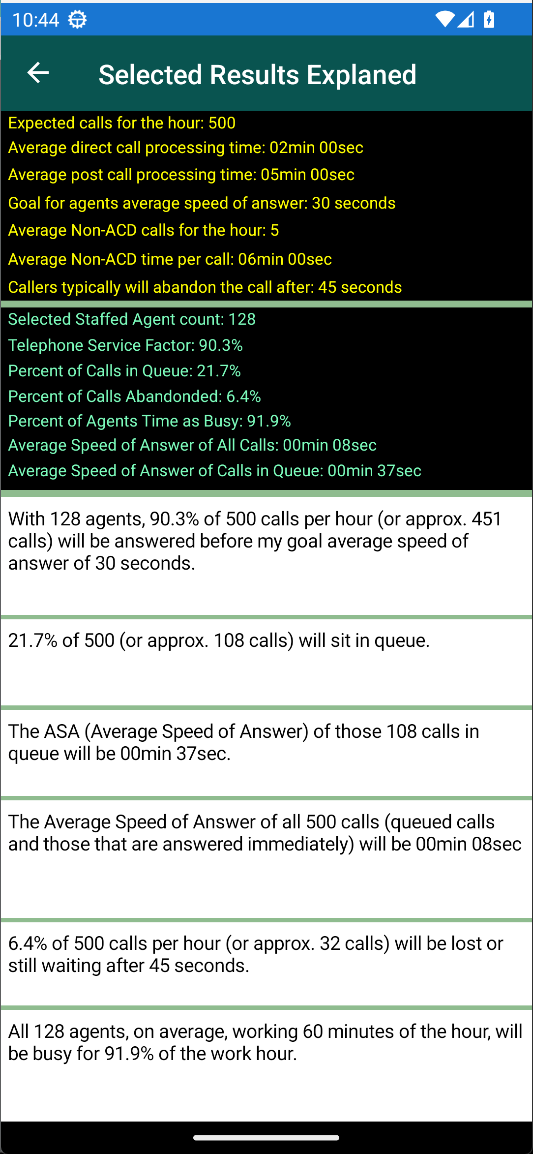
These existing assets still work well here and help show that this was not just an idea — it was already built and shipped as working software.
Need this built for your call center?
This traffic calculator can be rebuilt as a modern web application, an internal company tool, or a branded customer-facing calculator for operations teams that need faster staffing decisions. It can also be tailored to your terminology, reporting needs, and queue assumptions.